In 2026, artificial intelligence has transitioned from an experimental technology to a mandatory driver of business profitability. The most effective AI solutions delivering measurable Return on Investment (ROI) include intelligent workflow automation, predictive supply chain analytics, AI enhanced ERP systems, generative AI for customer service, dynamic pricing models, AI driven talent management, and automated risk compliance. By strategically deploying these seven use cases, organizations can drastically reduce operational costs, accelerate decision-making, and unlock sustainable revenue streams.
The State of AI in Business in 2026
The business landscape in 2026 is defined by a critical shift: companies are no longer asking If they should adopt Artificial Intelligence (AI), but how to maximize its financial return. The focus has moved entirely from flashy pilot programs to scalable, enterprise wide deployments that directly impact the bottom line.
According to recent industry benchmarks, including the annual state of AI research, organizations that embed AI into core business operations are seeing significant lifts in earnings before interest and taxes (EBIT). Furthermore, insights from Stanford’s AI Index Report highlight that AI investment is now heavily concentrated on practical applications like Machine Learning (ML), Natural Language Processing (NLP), and Agentic AI systems capable of making autonomous decisions within set parameters.
To achieve these results, businesses must focus on use cases that solve specific operational bottlenecks.
7 Practical AI Use Cases Driving ROI
The instinct many businesses have is to resist automation because it feels like handing over control. Done well, it’s the opposite.
The goal isn’t to remove people from the process – it’s to remove the keying from the process, and let people do the part that actually needs judgment: reviewing, approving, deciding. The best automation does the mechanical work and then stops, handing a clean, complete result back to a person for sign-off.
That’s the approach we take at Envinse: automate the data entry and the matching and the paperwork, but leave the decision – and the final approval – with the team.
A concrete example: accounts payable
7 Practical AI Use Cases Driving ROI
1. Intelligent Workflow and Process Automation
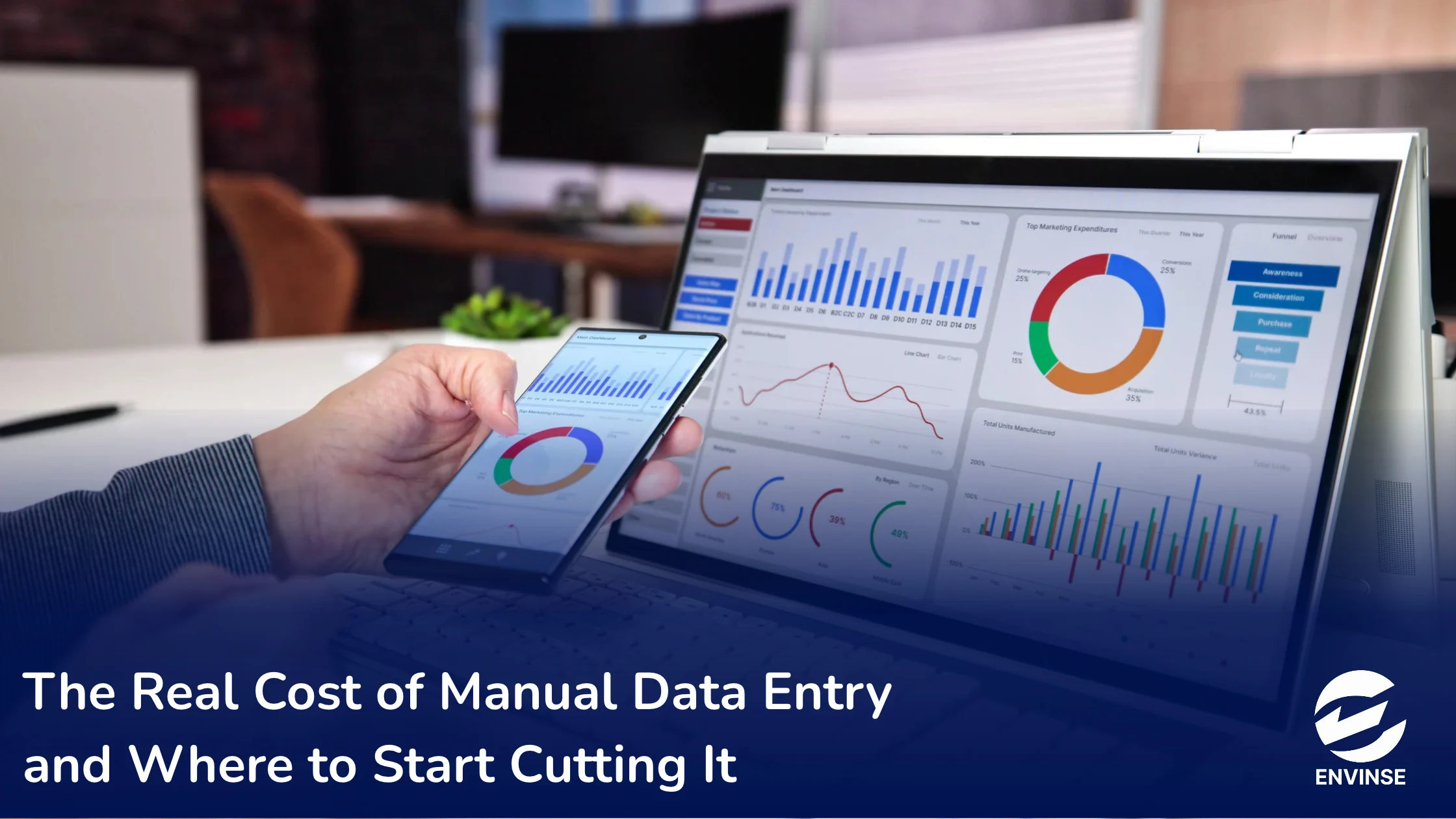
Manual data entry and repetitive administrative tasks are massive drains on productivity. In 2026, Robotic Process Automation (RPA) combined with AI often called Intelligent Automation can read, route, and process unstructured data like invoices and contracts without human intervention. Partnering with experts for Data, Analytics, and AI solutions allows businesses to transform manual processes into streamlined operations, reducing error rates and freeing employees to focus on high-value strategic work.
2. Predictive Analytics for Supply Chain and Inventory
Supply chain disruptions cost companies millions annually. Predictive analytics algorithms analyze vast datasets including historical sales data, seasonal trends, macroeconomic indicators, and even real time weather patterns to forecast demand with unprecedented accuracy.
- ROI Impact: Reduces carrying costs by optimizing inventory levels and minimizing warehouse space requirements.
- Business Value: Prevents stockouts and minimizes waste, particularly in manufacturing and retail sectors, ensuring that capital is not tied up in unsold goods.
3. AI Powered ERP Systems and Financial Anomaly Detection
Modern Enterprise Resource Planning (ERP) systems have integrated AI to move beyond mere data storage. In 2026, AI is moving from a dashboard feature to an active participant in ERP workflows, with agentic capabilities automating procurement, finance, and supply chain decisions without manual triggers. If an unusual expense, a duplicate invoice, or a sudden spike in vendor costs appears, the system flags it instantly. This proactive anomaly detection prevents financial leakage before it compounds, ensuring tighter fiscal control, faster month-end closes, and more accurate financial forecasting.
4. Generative AI in Customer Service and Support
Generative AI has revolutionized the contact center, turning it from a cost center into a value driver. Instead of rigid, rule based chatbots that frustrate users, businesses are deploying conversational AI agents that understand context, sentiment, and complex multi-part queries.
- First Contact Resolution: AI handles up to 70% of routine customer inquiries, such as order tracking and basic troubleshooting, instantly.
- Agent Copilots: For complex issues, AI assists human agents by instantly retrieving documentation, summarizing past interactions, and drafting responses. This slashes average handle times and significantly boosts customer satisfaction scores (CSAT).
5. Dynamic Pricing and Revenue Optimization
In highly competitive markets, static pricing leaves money on the table. AI driven dynamic pricing engines continuously analyze competitor pricing, market demand, inventory levels, and consumer behavior to adjust prices in real time. This use case is particularly lucrative in e-commerce, hospitality, and logistics. By finding the optimal price point that maximizes both sales volume and profit margins, businesses consistently deliver a measurable increase in gross margins without sacrificing market share.
6. AI Driven Talent Management and Workforce Upskilling
As highlighted in the World Economic Forum’s Future of Jobs Report, the integration of AI is fundamentally reshaping skill requirements across all industries. Businesses are using AI platforms to map internal skills, predict future talent gaps, and generate personalized learning paths for employees. By optimizing workforce allocation and improving retention through targeted upskilling, HR departments are turning AI into a powerful tool for human capital ROI, reducing the exorbitant costs associated with external hiring and onboarding.
7. Automated Risk Management and Compliance
Navigating complex regulatory environments is costly and prone to human error. AI systems can continuously scan internal communications, financial records, and operational data to ensure compliance with industry regulations. By aligning with established guidelines like the NIST AI Risk Management Framework, organizations can safely deploy AI to automate compliance audits. This significantly reduces legal risks, lowers the cost of manual auditing, and prevents the massive financial penalties associated with regulatory fines
How to Measure AI ROI Effectively
Implementing AI is only half the battle; measuring its success is crucial to justify ongoing investment. To ensure your AI initiatives are actually delivering ROI, track these key performance indicators (KPIs) rigorously:
- Time to Value (TTV): Measure how quickly the AI solution begins generating measurable results after deployment. Shorter TTV indicates a highly effective implementation.
- Operational Cost Reduction: Calculate the direct decrease in expenses related to manual labor, error correction, and process inefficiencies.
- Revenue Uplift: Track direct increases in sales or margins attributed to AI interventions, such as dynamic pricing adjustments or personalized product recommendations.
- Employee Productivity Metrics: Monitor the hours saved per week on routine tasks, allowing staff to pivot to revenue-generating, strategic activities.
- Customer Acquisition Cost (CAC) and Lifetime Value (LTV): Evaluate how AI driven marketing and customer service improvements lower the cost of acquiring new customers while extending their overall lifetime value.
Frequently asked questions
What is the fastest way to see ROI from AI in a small to mid-sized business?
The fastest ROI typically comes from implementing AI in customer service (like intelligent chatbots) or automating repetitive back office workflows (like accounts payable). These solutions have low barriers to entry and provide immediate cost savings.
Is AI too expensive for non enterprise businesses in 2026?
No. The rise of Cloud based AI and Software as a Service (SaaS) models means businesses no longer need to build proprietary models from scratch. Composable AI tools and API integrations make it highly affordable for mid-market companies to adopt enterprise-grade AI.
How do we ensure our AI solutions are secure and compliant?
Security must be built into the deployment strategy from day one. Utilize established frameworks like the NIST AI Risk Management Framework, ensure your data is encrypted, and work with certified implementation partners who prioritize data governance and role-based access controls.
Will AI replace my workforce?
Will AI replace my workforce?